Friday, June 26, 2009

'The Man In The Mirror' Vanished So Unceremoniously


In my schooldays (1983 - 1997) I grew up listening to Western music of a few selected rock n' roll bands and pop singers. Without a grain of doubt I can recall that the first name that flash across my mind when I think of one pop-star is none else but Michael Jackson.

A celebrity's life is not at its pinnacle if it doesn't have enough scandals which give critics their food for thought. Michael Jackson as a celebrity had enough of them. But, to me since my childhood, he has been an angel. His 'Heal The World' was like a hymn to us in school and the most frequently sung opening chorus on our Annual Day. It is the same song which we belted out to win the 2nd prize in an Inter University National Youth Festival.

I never had an inkling of an idea that the 'Man In The Mirror' would vanish away so soon!!

Monday, June 22, 2009

Two Major Moves By LIC And India Post

I am excited about two major moves going to be taken by two different financial services institutions in India. The first move is by Life Insurance Corporation of India (LIC) and the second one is by the Indian Postal Services Department aka India Post.

LIC will be implementing a project called Enterprise Document Management System (EDMS), which they plan to complete by 2011. It will enable LIC to extend 'Anywhere Anytime' service. They have already launched the project in 2007 partnered with Hewlett Packard (HP). It will enable the policy holders or their nominees to pay LIC premium or claim their settlement payment from any location in India. This would indeed make lives of 230 million policy holders across the country much hassle free. Also, the digitization of record of these policy holders will ensure archival of physical records in electronic form and will eliminate risks of loss or damage to physical records due to natural and other disasters.

The second move that I was referring to, by India Post is that they are going to provide on-site ATMs for their customers. To note India Post has 155,000 locations across the country. This would be a massive value-added service to the post-office savings bank account holders. The hours of waiting in long queues at post-offices for withdrawing or depositing money can be cut down substantially. India Post had 228.9 million savings bank accounts with an aggregate outstanding amount in these accounts of US$ 457.89 million (as on March-end 2009).

Saturday, June 20, 2009

Is Indian Economy Resilient To A Poor Monsoon?

Delayed monsoon and rising El Niño risks gives me a hint ... “are we going to see once again the market selloff during the drought of 2002?” The water reservoir levels are already low, and this factor coupled with poor monsoon may have adverse effects on farm income, and raise fiscal burdens. We are already halfway through in July and there has been no significant sign of onset of monsoon. My apprehension may turn out to be true depending on the progress in this month.

The year 2009 season has started on a bad note. The overall rainfall for the season until Jun 17 has been 45% below normal, with 28/36 meteorological divisions receiving rainfall below the long-term average. The water levels in reservoirs are at 10% of capacity (vs. norm of 14% for Jun). This is indeed an alarming situation. According to Australia’s Bureau of Meteorology, the signs of a developing El Niño, which usually lead to drought in Asia, have strengthened during the past fortnight. And if their predictions materialize in reality then we are definitely heading towards a crisis situation.

Indian agriculture is no more heavily dependent on monsoon. There has been much progress in the irrigation facility, and also the share of agriculture in GDP has declined. The share of the monsoon-dependent kharif crop has declined. Since 1987, agri output fell in only 5/8 years when monsoon rainfall was +5% below average. Also, the area under irrigation (now 43%) has been rising steadily, albeit gradually. This is a positive indication.

With agriculture now accounting for only 18% of GDP (versus 33% even in the early 1990s), the Indian economy is far more resilient to a poor monsoon season. However, a poor crop will deflate the current buoyancy in farm incomes. At a time of +10% fiscal deficits, there is little room for further fiscal support.

Tuesday, June 16, 2009

Investor Hostility and the Communist Governed States in India

In one of my earlier posts “Brand Bengal: It’s High Time to Rethink”, dated September 06, 2008 I had discussed the current state of investor hostility in the Communist regime in West Bengal. After the Dubai based Smart City decided to quit its ventures to set up self-sustained townships for information technology and knowledge-based industries near Kochi, Kerala I am compelled to think ‘is investor hostility plaguing communist governed states?’

The proposed Smart City was likely to generate direct employment for 80,000 people and provide indirect employment to another 20,000 people. This is only the employment generation aspect, besides this there are other aspects like revenue generation for the state in the form of taxes, and economic growth of the state which gets adversely affected. Added to this will be a domino effect wherein other investors restrain themselves from investing in projects in Kerala.

When the Tatas pulled out of its Nano project from Singur, West Bengal the immediate loss was over Rs. 5,000 crore and the potential loss was a whopping Rs. 80,000 crores. Smart City, Dubai had urged the Kerala state government to commit at least 12% free land out of the total 346 acres of land. The Kerala government still does not have a clear-cut answer to this issue and have dilly-dallied things.

Kerala and West Bengal are two states where the communists have ruled for long tenures and had once built a strong political base. In West Bengal the current public choice is against the red-brigade, they have been badly beaten in the Panchayat (local self-governments) elections followed by the Parliament elections. The story in Kerala is also similar, and if the investor hostility continues then the communist governments in these two states would have to pack their bags soon.

Tuesday, February 24, 2009

Slumdogs Are No Underdogs

The laurels that A. R. Rehman, Gulzar & Resul Pookutty brought to India at the centrestage of the Academy Awards function have enthralled every conscious Indian. We may have had loads of criticism against the portrayal of India's poverty and wretched condition of life of its slum-dwellers in this movie, but we cannot detach ourselves from dousing in the celebration for the victors who are very much Indian.

This is not the end of the story; India have once again proven her worth in another field - banking. Our very own State Bank of India (fondly known as SBI) have superseded Citigroup's market capitalisation to be among the largest banks in the world. The market capitalisation of SBI on Friday closed at Rs. 66,285 crore. This is around 25% more than the closing market capitalisation of Citigroup on the NYSE on Friday. The market capitalisation of Citigroup was Rs. 52,931 crore.

Though Citigroup's revenue in the last four quarters is almost eleven times more than the revenue earned by SBI, its profits are nowhere near the figures earned by SBI. While Citigroup has suffered losses of Rs. 83,474 crore in the last four quarters, SBI has booked profits of Rs. 8,262 crore. Martin Hutchinson, an economic commentator, recently put out a list on the status of the 12 largest banks in the US. He categorised Citi as a zombie bank. “Citi has been a serial flirter with bankruptcy over the past 30 years and remains a basket case,” he wrote.

Monday, January 12, 2009

Amazing Facts About The Big 4

The Big 5 (Sorry 4) accounting firms have been on the top of every finance professional's mind for some reason or the other. There are a couple of true but amazing facts about them, not known to many. Known as the Big 4 accounting firms they are:
(Arthur Anderson which made it the Big 5 is now in archives).

Of course they set the global standards for transparency in business. But who is their owner? Shhhhh ... It is a well-guarded secret. Even though present in over 120 countries, for obvious reasons each one of them is headquartered in a tax haven. If you enquire any details about these firms in a tax haven like Panama, you may end up spending the next 2 years in jail. Understand how secret the ownership is!

They have paid billions of dollars as fines in the U.S alone to the SEC. In U.K they are being subject to investigations under the Fair Trade Practices Act. They are the subject of cartoons in the western press and lampooned by the media.

They have been found innovative in:
  • Booking bogus sales
  • Capitalizing revenue expenses
  • Insider trading & related unethical practices
  • Not accounting sales returns
  • Inadequate disclosure of off-balance sheet items
  • Assisting the management in asset stripping
  • Failing to record liabilities or suppress liabilities

Well the list on their accounting "innovation" could go on ... That is if you do not reckon shredding of documents as an expert service. It is these 'credible' professional outfits that are in India, advising the Government of India on:

  • Speed and directions of reforms
  • Advisor to the planning commission
  • Providing expertise to the disinvestment process
  • Privatization and Globalization
  • Policies for inviting FDI

So if you want to innovate your accounts hire these "experts", they would do a good job for you and of course make a fortune in the bargain. If you are corporate manager, you may have personally felt bombarded, sullied, trampled over, bullied and even decried at your own office by representatives of the Big 4. Simply because they are from the Big 4. Remember, they charge you and you pay even for the time spent on abusing you!

If you are a decision maker you might have noticed subtle hints to influence your decisions. Hiring the kith and kin of the decision makers is one of their tried and trusted methods. They are experts in the art of making friends and influencing people. They are too good at Dollar Diplomacy!

Their ownership is unknown, their competency is suspect and their advice bogus. Then, why do the financial institutions, banks and the corporates in India keep them as auditors, advisors or consultants? Why are they allowed to operate in India, and hired and respected by the Government of India? WHY?

Simply because we are not aware of these firms and therefore we are silent. The need of the hour is to create public awareness.

Thursday, January 1, 2009

Silver Tsunami

On February 12, 2008, America's first baby boomer, Kathleen Casey-Kirschling, received her first Social Security payment. That was just the beginning. Over the next 20 years, 80 million boomers (those born between 1946 and 1964) will begin collecting Social Security. That's an average of more than 10,000 per day. The wave of retiring boomers has been dubbed the "silver tsunami".

When World War II ended, there were 44 people paying into Social Security for every retiree. Now only three people pay in, for each person taking out, and it could be bankrupt by the year 2043. So, if Social Security doesn't benefit from boomers retiring, who does?
Courtesy: Will Ashworth

Tuesday, December 23, 2008

Ten Surprises for 2009

In a collaborative effort between Global Equity Strategy and Global Asset Allocation, and in keeping with their year-end tradition, UBS presented in their final publication of 2008 a list of ten possible ‘surprises’ for the coming year. Its aim is to identify plausible scenarios, representing risks—up or down—to investor consensus thinking, and in some cases, to its own views.

UBS' list of ‘surprises’ include:

1) Corporate default rates don’t rise significantly;

2) Oil prices fall below $20 per barrel;

3) The dollar falls to new lifetime lows;

4) Breakeven inflation rates remain near zero;

5) Global growth is negative for 2009;

6) The Fed purchases corporate credit;

7) Emerging markets regain parity valuations;

8) Equity ‘fallen angels’ soar;

9) Obama pushes for a ‘tax holiday’; and,

10) Gold goes to $300.

Perhaps next year the surprises will be somewhat more positive? Who knows! Now let us take a look at their last years' surprises (predictions) and compare their conjectures to actual outcomes.

1) Global growth surprises on the upside: Did it happen? No.

2) Oil prices: Is 50 the new 20? Did it happen? Yes.

3) The dollar appreciates: Did it happen? Yes.

4) World trade clouds: Did it happen? Sort of.

5) Developed deflation, developing inflation: Did it happen? No.

6) Financials outperform: Did it happen? No.

7) Emerging equity markets under-perform: Did it happen? Yes.

8) Japanese equities outperform: Did it happen? It depends.

9) Equity volatility settles at lower levels: Did it happen? No.

10) Chinese inflation falls sharply: Did it happen? Yes.

With a success ratio of 40% in their last year's predictions it attests that this exercise has merit. At least it can provide an avenue for 'out of the box' thinking which can aid risk management. Whether their predictions hold good or live upto its own benchmark is a question that only time can answer. Let's wait and watch!!


Sunday, December 21, 2008

Market Failure and the Big Three

It was much debated on whether the Federal Reserve should bailout the U.S auto industry or not. Many were of the opinion (with a conservative view) that the Big Three could probably survive and be competitive if the U.S government would let them go into Chapter 11 bankruptcy instead of bailing them out with taxpayers’ money.

In a capitalist economy, government intervention is less likely and less welcome unless there is a market failure which has far reaching effects. The fall of the Big Three would have been an imminent danger to the U.S.A's national economy. President Bush's order for an emergency bailout of the U.S auto industry offering $17.4 billion have risen mixed feelings. The autoworkers union complained the deal was too harsh on its members, while Bush's fellow Republicans in Congress said it was simply bad business to bail out yet another big industry.

To my opinion the Fed's decision is perfect as it could not afford to allow the massive auto industry to collapse when the economy is already in the middle of an economic downturn. The Big Three's fall could send the U.S economy into a deeper and longer recession. But, it is also high time for the U.S auto companies to reform bad management practices and begin the long-term restructuring to safeguard the millions of jobs it provides.

Saturday, December 13, 2008

Chiquita, Not Just Bananas!

The name Chiquita in the western world is synonymous to a banana. But there's a lot more to Chiquita than just bananas!

The company's website parade about its ethical business practices without shame or modesty which they hardly practise in reality:

In March 2007, Chiquita was convicted of federal criminal charges for making more than 100 payments, totaling more than $1.7 million, to the United Self-Defense Committees of Colombia (Autodefensorias Unidas de Colombia or AUC), which has been designated as a Foreign Terrorist Organization by the U.S. government. Chiquita paid a $25 million fine.
In July, 2007 Colombian families represented by EarthRights International (ERI), together with the Colombian Institute of International Law (CIIL), Judith Brown Chomsky, and Schonbrun DeSimone Seplow Harris & Hoffman LLP (SDSHH), filed a federal class-action lawsuit charging Chiquita Brands International, Inc., the multi-national produce company, with funding and arming known terrorist organizations in Colombia in order to maintain its profitable control of Colombia’s banana growing regions starting in the mid-1990s.

Chiquita’s payments to these paramilitary groups, including the AUC and its predecessors, were reviewed and approved by senior executives of the corporation, and resulted in the targeted killings of hundreds or thousands of individuals, including trade unionists, banana workers, and political organizers. It is also said that the company have been engaging women and child labourer in their plantations in El-Salvador, Colombia and other Central American nations, who were made to work under inhumanic working conditions.

It flaunts its 'Code of Conduct' (CoC) and holds it up as the representative of its ethics and compliance program. Apparently, going by the CoC of the company, it looks like the company is deep-rooted in strong fundamentals. But, the dark-side of the company's economic activities is scary.

Tuesday, December 9, 2008

DEEPENING WOES FOR JAPAN


In the face of the global financial meltdown it is now predicted that the recessionary situation in Japan may deepen further. The previous record was three quarters in a row, as in the last contraction seven years ago in the wake of the dot.com bust.

High oil prices were the primary cause for economic slowdown in Japan until the third quarter. But, what is currently being observed that Japanese companies are curtailing production at an unprecedented pace as demand plunges not just in the United States and Europe but also in emerging nations that had until recently weathered the global financial storm. The situation is aggravated further by the sharp appreciation in yen.


Economists have been expecting a 0.4 percent contraction in fiscal 2008/09 but that now needs to be revised down. It's hard to see at this point how the economy will return to a recovery. The sharp fall in oil price and other commodity prices should positively impact Japanese consumption but there is still time when the positive effects are felt.

Saturday, December 6, 2008

Commodity, Debt and Currency

This is the most comprehensive comparison that can be drawn between the current trend in the prices of major commodities (like gold, crude, copper and aluminium), yield on 10 year Government Securities and, Indian rupee - US $ exchange rate.

The exchange rate just cleared the highest mark in the last eight months and is probably on a slight downward swing. Prices of gold, copper and aluminium has slashed down considerably; the volatality being the highest in gold price. The yield on 10-year government bond is also at the lowest point in the last eight months.

If we look at the gold price fluctuations then we see that in every four months during the last eight months it has progressively increased, peaked and then went down again; this was almost cyclical. If the same trend (or cyclicity) continues then it is the right time to invest in gold as it is expected to go up and peak in another four months' time. As the world demand for gold has absorbed quite large quantities of Central banks gold stocks over the past decade, with only a fairly small downward effect on prices, we believe that gold prices are more likely to increase over the next few years than to decrease. Certainly the upside potential must now be considerably stronger than the downside potential.

The decline in copper and aluminum price is expected to be reflected in lowering of prices of finished goods using these metals as inputs (such as auto-ancilliaries). The fall in crude oil prices would definitely be a sigh of relief for the oil refining and retailing companies like IOCL, HPCL, etc. The depreciation of Indian rupee against US$ would definitely benefit the exporters on one hand, but would have adverse effect on the importers.

A basic property of a bond is that its price varies inversely with yield. The reason is simple. As the required yield increases, the present value of the cash flow decreases; hence the price decreases. Conversely, when the required yield decreases, the present value of the cash flow increases; hence the price increases. In the current scenario a declining bond yield would result in rise in its price.

Thursday, December 4, 2008

The Indian Satellite And Cable Space

Indian cable & satellite (C&S) space is valued at Rs. 167 bn, growing at a brisk pace of ~22% p.a. Despite being the largest segment in the Indian Media & Entertainment industry, almost all players within the space have been suffering losses due to lack of addressability in the analogue transmission mode and high level of fragmentation as a result of low entry barriers. However, the space is all set for a phase of sustained digitization and consolidation led by consumer demand for quality and technology making it affordable. It is believed that half of India's C&S homes will be converted to digital by 2015, creating one of the world's largest digital subscriber base.

The Indian cable and satellite space (C&S space) comprises of delivery of TV signals to consumers through cable, satellite or broadband. The industry is a decade and a half old, third largest in the world in terms of cable network reach, and highly fragmented and unorganized because of low entry barriers in the analogue mode. The C&S distribution segment is the last leg in the television industry's value chain which comprises of content producers, broadcasters, Multi System Operators (MSOs), Local Cable Operators (LCOs) and satellite players. Even though the sector comprises 28% of the total entertainment and media industry and is growing at 22% per annum, most of the value creation is being cornered by the LCOs due to lack of addressability in the value chain. However, we believe that the sector is all set to witness disruptive change brought through technology, which will shift the balance of power towards MSOs and DTH players, unlocking huge value for operators in this space.

Saturday, November 29, 2008

How Exposed Are Our Auto Ancilliaries?

In India the demand for passenger vehicles (PVs) and commercial vehicles (CVs) have declined by 2.2% and 14.5% respectively during August - October 2008. This has resulted in a slowdown in India's auto ancilliaries. From the above table it is observed that currently exports account for 20% of sales for Indian auto ancilliaries. The lion share of their sales goes to domestic market. As the market demand in most global auto markets have been pressurized, the auto ancilliaries having high exposure to domestic and global OEs are likely most susceptible to a decline in sales and profitability.

The data shown above reveals that the companies (like Exide, SKF India, Apollo Tyres, MRF) that have strong exposure to the domestic replacement market are relatively better-off to counter the market slowdown. However Chinese imports could be a threat for tyre companies. The vendors will reap benefits of the lower commodity prices and rupee depreciation in the near term but, it will be slightly offset by drop in realisations as the market demand is cooling down. Nevertheless domestic OEs (especially two-wheeler manufacturers) will likely benefit from lower component prices.

Saturday, November 22, 2008

Pink Slips

I was reading an article by Saritha Rai on Indian Express website titled 'I signed the letter, took the cheque and walked out... it was over in five minutes'. The protagonist of the story is a 27-year old professional in India's outsourcing industry who had only seen the good times ... and was sacked unceremoniously from his company, the obvious reason being the "bad market conditions".

What I want to say is, what we always heard of happening in the West has arrived in our Bangalore as well. I think the situation is similar, if not more morbid, in Gurgaon, Noida, Pune or Hyderabad where the outsourcing industry is the mainstay of their economies. During my years of working (2005 - 2007) at Convergys in Gurgaon, I have seen how the young professionals took the advantage of the explosion in the outsourcing industry by hopping companies, demanding and getting handsome pay hikes.


Many of my peers lived a lavish lifestyle on their plastic money; a few of them had bought a house or owned a car by taking loans. I can imagine if some of them lose their jobs in a jiffy may land up in a jobless state with a market debt of Rs. 30 - 40 lacs (60 - 80 thousand US$). Most of these young professionals were spendthrift and had the least propensity towards savings. In the past years the same people who were besieged with jobs are now having the nightmare of "pink slip".


But the recent, serial bust-ups in Wall Street and a recessionary US economy has badly hit Indian outsourcing firms. With American companies — their biggest customers — facing an economic dip, outsourcing companies are cutting back and, in turn, choking the job market. As a ripple effect it is showing up in unexpected ways in Bangalore; restaurants and drinking lounges reporting 30% - 50% dip in revenues, real-estate companies slashing prices of apartments and introducing low-end options, and outsourcing workers switching over to two-wheelers and company cabs rather than driving their cars.

Sunday, November 16, 2008

A Jeffersonian Statement

Thomas Jefferson wished to be remembered for three achievements in his public life. On his tombstone, it reads that Thomas Jefferson was "author of the Declaration of American Independence, of the Statute of Virginia for religious freedom, and Father of the University of Virginia" and, as he requested, "not a word more." Historians might want to add other accomplishments--for example, his distinction as an architect, naturalist, and linguist--but in the main they would concur with his own assessment.

In 1802, during the years of his presidency, he made the following statement which shows his ability to envision future.

"I believe that banking institutions are more dangerous to our liberties than standing armies. If the American people ever allow private banks to control the issue of their currency, first by inflation, then by deflation, the banks and corporations that will grow up around the banks will deprive the people of all property until their children wake-up homeless on the continent their fathers conquered."

This is more or less the exact situation that America is subjected to now.

Saturday, November 15, 2008

Real Estate Developers Are Faced With Severe Liquidity Crunch

As a result of rising interest rates on home loans and reluctance on the part of developers to reduce prices on their projects, demand for real estate in India has slowed significantly, leading to significantly lower cash generation for real estate companies. Developers are now faced with a severe liquidity crunch, as the worsening macro environment coupled with the increased risk perception of the sector has made fundraising extremely challenging.

Real estate developers have relied on short-term debt (40-50% of total debt) for financing land purchases and funding construction of leased assets. Many companies have reported that borrowing costs have increased by 250-300 bp over the past few months, the bigger issue has been availability of financing – news articles and market stories suggest that a number of banks and mutual funds have stopped lending to real estate developers fearing defaults. Given slowing sales and weak cash-generation, it is estimated that some developers will be hard pressed to meet their repayment commitments.

Another issue is monies raised by some of the promoters of these real estate companies by pledging their shareholding – the impact of which is extremely difficult to assess given the lack of transparency in such transactions, which increases the perceived risk of companies.

Wednesday, November 12, 2008

Asia Is More Attractive


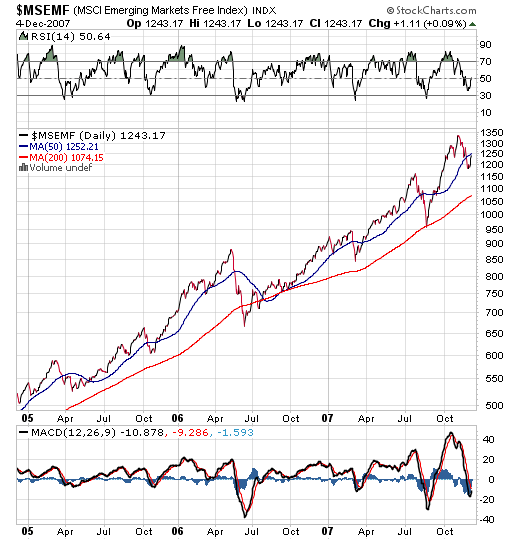
The Morgan Stanley Capital International (MSCI) emerging markets stock index is down 55 percent year-to-date. Investors caught up in the credit crisis sold their profitable emerging market positions in order to raise cash to protect their core positions. This deleveraging process has been indiscriminate across regions, countries and asset classes and continues even as central banks and governments shove cash into the markets in order to keep up the flow of money in the credit markets.


But, emerging market equity prices are expected to bounce back from the indiscriminate dumping of the sector faster than developed stock markets. In particular, Asian emerging market stocks are now expected to outperform their peers because the sharp decline in commodity prices will bring down their manufacturing costs and make them more competitive in exports as well as feed resilient domestic demand.


China's benchmark Shanghai Composite Index is down nearly 65 % year-to-date while India's 30-share BSE Index is down 51.50 % over the same period. India is a lot less expensive than they were but nevertheless, relative to other emerging markets, it remains one of the more expensive stock markets. Russia at 3.5 times perspective earnings versus 7.5 times for emerging generally makes Russia cheapest market in the world. As for Egypt, it tends to have a relatively low correlation with both developed and emerging markets because it is under-owned and has more investment coming from the region or from domestic sources.

Monday, November 10, 2008

Global Needs Assessment: People Are Still Less Welcome

International migration is part of today’s often discussed globalization. International movement of capital, goods, and labor have accelerated the pace of industrialization yet, today capital and goods move freely across borders, but people are less welcome. All developed countries have received significant numbers of migrants irrespective of the continent they are situated in.
In 2009, UNHCR is launching an annual Global Needs Assessment (GNA) in its operations worldwide to comprehensively map the real state of the world's refugees and people of concern under its mandate.

The aim is to outline the total needs, the costs of meeting them and the consequences of any gaps. The GNA will be a blueprint for planning, decision-making and action with governments, partners, refugees and people of concern.

In early 2008, a pilot GNA using a rigorous methodology drawn from UNHCR's Strengthening Protection Capacity Project, was carried out in eight countries – Cameroon, Ecuador, Georgia, Rwanda, Thailand, Tanzania, Yemen and Zambia. It focused on the unmet needs of refugees, internally displaced people, returnees, asylum seekers and stateless people.

The results published in the report 'Refugee Realities' revealed a sobering reality of substantial and disturbing gaps in protection, including basic needs such as shelter, health, education, food security, sanitation and measures to prevent sexual violence. It showed that a startling 30 percent of needs were unmet in the pilot countries – a third of them in basic and essential services. UNHCR is already actively involved in these sectors, but not to the levels required.

Results showed a clear need to improve and ensure access to asylum systems with better reception facilities and procedures, registration, documentation and border monitoring. Training and technical support are also needed to increase the capacity of governments to adequately respond to people of concern. Women and children require better protection with improved prevention and response measures for sexual abuse and violence, as well as strengthened child protection programmes.

To address the needs gap in the eight pilot countries, UNHCR has included requirements totalling $63.5 million in its 2009 budget.

In a parallel effort to the GNA pilot, all UNHCR field offices provided their rough estimates of the financial requirements to meet the total needs of each population of concern. The global total reached USD3.8 billion, highlighting the stark reality that UNHCR has only a portion of the funding required for its responsibilities towards 31.7 million people of concern at the current annual funded budget of USD1.8 billion.

With a current operating budget that cannot support all needed interventions, UNHCR must make tough decisions on prioritizing, to the detriment of those it is mandated to protect.

Thursday, November 6, 2008

Barack Obama: From Frying Pan To Fire

Obama’s domestic agenda is clearly ambitious and will undoubtedly be an aggressive repudiation of the policies of the past eight years. It is an agenda heavily dependent on tax increases from higher-income earners, which should be supported by a like-minded. However, Obama’s aspirations may be constrained by external factors beyond his control. Even with expanded Democratic majorities in Congress, the political reality is that the financial crisis will likely dominate his playing field, hampering to some degree his ability to tackle the other pillars of his domestic agenda.

As the federal government responds to the credit crunch and growing recessionary pressure, Obama will need to dedicate significant federal funding to expedite recovery, thereby siphoning money from other priorities and increasing pressure on the national deficit and debt. The final 100 days of the Bush administration have been a churning cauldron for the President and the markets, and Obama will quickly learn what it is like to go from the frying pan into the fire.

Wednesday, November 5, 2008

Indian Commercial Banks: Even More Privileged Now

Over the last 45 days, RBI has lowered high Reserve requirements by up to 7% of deposits (20%+ of SLR/CRR), narrowed the repo/reverse-repo corridor by 150bps, and been proactively accommodative (rather than preachy) of banks’ liquidity and other needs. These actions are precipitated by extraneous events, possibly temporary in nature, and (in part) mirror global actions. But they could represent the beginning of a structural thaw in the overtly cautious and economically burdensome policy environment for India’s banks.

India’s banks have always dominated the domestic financial landscape – garnering 50%+ of household savings and 90%+ of system deposits. They were, however, being increasingly challenged (on the savings and lending sides) by rapidly growing MFs, life insurers, and in-flowing foreign capital. This has probably changed with capital savers and users flocking to banks (with fairly implicit backing of the government/RBI), commercial banks now appear even more privileged.

Monday, November 3, 2008

RBI's Mid-Term Review of the Annual Policy Statement for 2008-09

The Reserve Bank of India has reviewed the current and evolving macroeconomic situation and liquidity conditions in the global and domestic financial markets. In its Mid-Term Review of the Annual Policy Statement for 2008-09, the Reserve Bank of India indicated that in the context of the uncertain and unsettled global situation and its indirect impact on our domestic economy and our financial markets, it would closely and continuously monitor the situation and respond swiftly and effectively to developments. In doing so, the Reserve Bank will employ both conventional and unconventional measures. Global financial conditions continue to remain uncertain and unsettled, and early signs of a global recession are becoming evident. These developments are being reflected in sharp declines in stock markets across the world and heightened volatility in currency movements. International money markets are yet to regain calm and confidence and return to normal functioning.

It was also indicated in the Mid-Term Review that the current challenge for the conduct of monetary policy is to strike an optimal balance between preserving financial stability, maintaining price stability and sustaining the growth momentum. Inflation, in terms of the wholesale price index (WPI), has been softening steadily since August 9, 2008 and has declined to 10.68 per cent for the week ended October 18, 2008. Globally, pressures from commodity prices, including crude, appear to be abating. The moderation in key global commodity prices, if sustained, would further reduce inflationary pressures. On the growth front, it is important to ensure that credit requirements for productive purposes are adequately met so as to support the growth momentum of the economy. Domestic financial markets have been functioning normally. Prudent regulatory surveillance and effective supervision have ensured that our financial sector has been and continues to be robust. However, the global financial turmoil has had knock-on effects on our financial markets; this has reinforced the importance of focusing on preserving financial stability.

Saturday, November 1, 2008

Not Far Away From 10,000

India’s bellwether stock index, the Bombay Stock Exchange’s (BSE) Sensex, soared towards the psychologically important 10,000 mark on Friday, powered by pent-up energy from traders who missed Thursday’s strong rally in Asian markets because Indian markets were closed on account of Bhai Dooj, a Hindu festival.
The Sensex closed at 9,788, adding 8.22% or 743 points, but analysts said the rally will last if only the central bank steps in with aggressive support by cutting rates and releasing money into the system.
After the recent spate of rate cuts by central banks across the globe, led by the US Federal Reserve, many more central banks are expected to announce rate cuts next week. This could see at least some of the funds parked in safe and liquid US treasury bonds coming back to Asian equity markets, according to global analysts. The allocation of such capital will favour those Asian markets where central banks are more focused on growth, these analysts add.

Friday, October 31, 2008

New U.S. Nuclear Trade With India: Liability Of The Provider

The U.S. had barred American companies from selling nuclear reactors, fuel, services and technology to India after India's atomic bomb test in 1974. Congress passed legislation lifting that ban earlier this month. Thereafter there has been a rally between U.S based General Electric Co. (GE), Paris based Areva SA, and Russia's Rosatom Corp. to clench the deal to sell nuclear-energy supplies to India.

The question is should the UPA government ratify that suppliers of nuclear plants and technology be granted a legal safeguard? India has a very bad experience already with a disaster caused by the Union Carbide factory in Bhopal in 1984, which had claimed 3,800 lives. Thus, it's essential that there be some kind of liability regime in place. It is agreed that this form of liability is extraordinary because there's no private market to purchase insurance against a nuclear incident. Yet, any agreement for the provision of nuclear reactors from any country, including the United States, has to carry with it the most important aspect -- the liability of the provider. 

The liability treaty is known as the Convention on Supplementary Compensation for Nuclear Damage. It makes plant operators, usually a utility, responsible for damages from any accident and shields suppliers from liability. Operators must set aside about $450 million for compensation in case of damage, and governments that sign the treaty would cover additional claims.

To my opinion there should be some sovreign immunity cover on the supplier through partial or full control by governments. In absence of it, we may probably have to recount the story of Bhopal disaster in the event of a nuclear accident.

Wednesday, October 29, 2008

FINANCIAL STRESS: A SYMPTOM OR A CAUSE

Greg Mandel, the chief economist for BusinessWeek has raised a question "Is the market and economic turmoil nothing more than a crisis of confidence?" His question is in response to what has been told by Ben Bernanke to the Economic Club of New York on Oct. 15:
"At the root of the problem is a loss of confidence by investors and the public in the strength of key financial institutions and markets."

The Bernanke-Paulson paradigm is based on the rationale that the financial turbulence will cease as the confidence of the investors are restored, and they start putting money back into the stock markets and companies around the world. Here Mandel once again challenges the view. He asks "what if the Bernanke-Paulson view is wrong? What if financial stress is a symptom, not a cause?"

It is highly likely that over the years people have realized that the way cross-border technological transfer, foreign trade and financial integration have taken place cannot be maintained over a longer period of time. The U.S transferred technology and business know-how to other low-wage emerging economies like India and China. The goods and services produced on a massive scale in these emerging economies were moved to the U.S assuming that there will be perpetual consumption demand. And, the financial flow was from the rest of the world to the U.S to finance their trade deficit.

This is good till such time your consumption demand is backed by your earning potential. You cannot pay back your debt with falling income. By BusinessWeek's calculations, in the U.S, real weekly earnings for college grads without an advanced degree have dropped every year since 2002.

Thus the panacea to the current crisis is not just restoration of investors' confidence but, developing innovative new products and services that the U.S can produce and sell in the global markets. It's high time for the U.S policymakers to get back to action to reduce the external borrowings the country has to do, and help create a sustainable global economy.